






radis.lbl.loader module
Summary
Module to host the databank loading / database initialisation parts of
SpectrumFactory. This is done through SpectrumFactory
inheritance of the DatabankLoader class defined here
Routine Listings
PUBLIC METHODS
radis.lbl.loader.DatabankLoader.load_databank()>>> load line databaseradis.lbl.loader.DatabankLoader.init_databank()>>> load loaderradis.lbl.loader.DatabankLoader.fetch_databank()>>> fetch from HITRAN onlineradis.lbl.loader.DatabankLoader.init_database()>>> to interact / generate a SpectrumDatabaseradis.lbl.loader.DatabankLoader.get_partition_function_interpolator()radis.lbl.loader.DatabankLoader.get_partition_function_calculator()
PRIVATE METHODS - DATABASE LOADING
radis.lbl.loader.DatabankLoader._load_databank()radis.lbl.loader.DatabankLoader._reload_databank()radis.lbl.loader.DatabankLoader._check_line_databank()radis.lbl.loader.DatabankLoader._retrieve_from_database()radis.lbl.loader.DatabankLoader._build_partition_function_interpolator()radis.lbl.loader.DatabankLoader._build_partition_function_calculator()
Most methods are written in inherited class with the following inheritance scheme:
DatabankLoader > BaseFactory >
BroadenFactory > BandFactory >
SpectrumFactory
.. inheritance-diagram:: radis.lbl.factory.SpectrumFactory
- parts:
1
Notes
RADIS includes automatic rebuilding of Deprecated cache files + a global variable
to force regenerating them after a given version. See "OLDEST_COMPATIBLE_VERSION"
key in radis.config
- class ConditionDict[source]
Bases:
dictA class to hold Spectrum calculation input conditions (
Input), computation parameters (Parameters), or miscellaneous parameters (MiscParams). Works like a dict except you can also access attribute with:v = a.key # equivalent to v = a[key]
Also can be copied, deepcopied, and parallelized in multiprocessing
Notes
for developers: Parameters and Input could also have simply derived from the (object) class, but it may have missed some convenient functions implemented for dict. For instance, how to be picked / unpickled.
See also
- class DatabankLoader[source]
Bases:
object
See also
- df0[source]
initial line database after loading. If for any reason, you want to manipulate the line database manually (for instance, keeping only lines emitting by a particular level), you need to access the
df0attribute ofSpectrumFactory.Warning
never overwrite the
df0attribute, else some metadata may be lost in the process. Only use inplace operations. If reducing the number of lines, add a df0.reset_index()For instance:
from radis import SpectrumFactory
sf = SpectrumFactory(
    wavenum_min= 2150.4,
    wavenum_max=2151.4,
    pressure=1,
    isotope=1)
sf.load_databank('HITRAN-CO-TEST')
sf.df0.drop(sf.df0[sf.df0.vu!=1].index, inplace=True)   # keep lines emitted by v'=1 only
sf.eq_spectrum(Tgas=3000, name='vu=1').plot()
df0contains the lines as they are loaded from the database.df1is generated during the spectrum calculation, after the line database reduction steps, population calculation, and scaling of intensity and broadening parameters with the calculated conditions.See also
df1- Type:
pd.DataFrame
- df1[source]
line database, scaled with populations + linestrength cutoff Never edit manually. See all comments about
df0See also
df0- Type:
pd.DataFrame
- fetch_databank(source='hitran', database='default', parfunc=None, levels=None, levelsfmt='radis', load_energies=False, include_neighbouring_lines=True, parse_local_global_quanta=True, drop_non_numeric=True, db_use_cached=True, lvl_use_cached=True, memory_mapping_engine='default', load_columns='equilibrium', parallel=True, extra_params=None, **kwargs)[source]
Fetch the latest files from [HITRAN-2020], [HITEMP-2010] (or newer), [ExoMol-2020] or [GEISA-2020] or [Kurucz-2017], and store them locally in memory-mapping formats for extremely fast access.
- Parameters:
source (str) – Which database to use. Options are
'hitran','hitemp','exomol','geisa','kurucz','nist'.database (str) – If fetching from HITRAN,
'full'downloads the full database and registers it,'range'downloads only the lines in the range of the molecule. If fetching from HITEMP, Kurucz, or NIST, only'full'is available. If fetching from ExoMol, use this parameter to choose which database to use. Keep'default'to use the recommended one. If no database is recommended (e.g., for13C-16O), you must explicitly provide one or aKeyErrorwill be raised. Default is'full'.
- parfunc: str or None
Path to a tabulated partition function file to use. This argument only affects molecules.
- levels: dict or None
Path to energy levels (needed for non-eq calculations). Format: {1:path_to_levels_iso_1, 3:path_to_levels_iso3}. This argument only affects molecules. Default is
None.- levelsfmt: str or None
How to read the previous file. Known formats:
'cdsd-pc','radis'or any ofKNOWN_LVLFORMAT. This argument only affects molecules. Default is'radis'.- load_energies: bool
If
False, don’t load energy levels. This means that nonequilibrium spectra cannot be calculated, but it saves some memory. This argument only affects molecules. Default isFalse.- include_neighbouring_lines: bool
If
True, includes off-range, neighbouring lines that contribute because of lineshape broadening. Default isTrue.- parse_local_global_quanta: bool or
'auto' If
True, parses the HITRAN/HITEMP ‘glob’ and ‘loc’ columns to extract quanta identifying the lines. Default isTrue.- drop_non_numeric: bool
If
True, non-numeric columns are dropped. This improves performance. Default isTrue.- db_use_cached: bool or
'regen' Use cached database if available.
- memory_mapping_engine: str
Which library to use to read HDF5 files. Options are
'pytables','vaex','feather'. Default is'default'.- parallel: bool
If
True, uses joblib.parallel to load database with multiple processes. Default isTrue.- load_columns: list,
'all','equilibrium','noneq',diluent Columns names to load. Default is
'equilibrium'.
Notes
HITRAN is fetched with Astroquery or HAPI, and HITEMP with
fetch_hitemp(). HITEMP files are generated in a ~/.radisdb database.See also
References
- get_abundance(molecule, isotope)[source]
Get isotopic abundance
- Parameters:
molecule (str)
isotope (int, or list) – isotope number, sorted in terrestrial abundance
Examples
Use it from SpectrumFactory:
sf.get_abundance("H2O", 1)
sf.get_abundance("CH4", [1,2,3])
Examples using
radis.lbl.loader.DatabankLoader.get_abundance¶See also
- get_conditions(ignore_misc=False, add_config=False)[source]
Get all parameters defined in the SpectrumFactory.
- Other Parameters:
ignore_misc (boolean) – if
True, then all attributes considered as Factory ‘descriptive’ parameters, as defined inget_conditions()are ignored when comparing the database to current factory conditions. It should obviously only be attributes that have no impact on the Spectrum produced by the factory. DefaultFalse
- get_partition_function_calculator(molecule, isotope, elec_state)[source]
Retrieve Partition Function Calculator.
- Parameters:
molecule (str)
isotope (int)
elec_state (str)
- get_partition_function_interpolator(molecule, isotope, elec_state)[source]
Retrieve Partition Function Interpolator.
- Parameters:
molecule (str)
isotope (int)
elec_state (str)
- get_partition_function_molecule(molecule)[source]
Retrieve Partition Function for Molecule.
- Parameters:
molecule (str)
- init_databank(*args, **kwargs)[source]
Method to init databank parameters but only load them when needed.
Databank is reloaded by
_check_line_databank()Same inputs Parameters asload_databank():- Parameters:
name (a section name specified in your
~/radis.json) –.radishas to be created in your HOME (Unix) / User (Windows). If notNone, all other arguments are discarded. Note that all files in database will be loaded and it may takes some time. Better limit the database size if you already know what range you need. See Configuration file andDBFORMATfor expected~/radis.jsonformat- Other Parameters:
path (str, list of str, None) – list of database files, or name of a predefined database in the Configuration file (
json) Accepts wildcards*to select multiple filesformat (
'hitran','cdsd-hitemp','cdsd-4000', or any ofKNOWN_DBFORMAT) – database type.'hitran'for HITRAN/HITEMP,'cdsd-hitemp'and'cdsd-4000'for the different CDSD versions. Default'hitran'format to read tabulated partition function file. If
hapi, then HAPI (HITRAN Python interface) [1]_ is used to retrieve them (valid if your database is HITRAN data). HAPI is embedded into RADIS. Check the version. If partfuncfmt is None then it is inferred fromformat(e.g.hapiforhitran,exomolforexomol). DefaultNone.parfunc (filename or None) – path to tabulated partition function to use.
hapi.py file. If not given, then the hapi.py embedded in RADIS is used (check version)
levels (dict of str or None) – path to energy levels (needed for non-eq calculations). Format: {1:path_to_levels_iso_1, 3:path_to_levels_iso3}. Default
Nonelevelsfmt (‘cdsd-pc’, ‘radis’ (or any of
KNOWN_LVLFORMAT) orNone) – how to read the previous file. Known formats: (seeKNOWN_LVLFORMAT). Ifradis, energies are calculated using the diatomic constants in radis.db database if available for given molecule. Look up references there. IfNone, non equilibrium calculations are not possible. Default'radis'.db_use_cached (boolean, or
None) – ifTrue, a pandas-readable csv file is generated on first access, and later used. This saves on the datatype cast and conversion and improves performances a lot. But! … be sure to delete these files to regenerate them if you happen to change the database. If'regen', existing cached files are removed and regenerated. It is also used to load energy levels from.h5cache file if exist. IfNone, the value given on Factory creation is used. DefaultNoneload_energies (boolean) – if
False, dont load energy levels. This means that nonequilibrium spectra cannot be calculated, but it saves some memory. DefaultTrueinclude_neighbouring_lines (bool) –
True, includes off-range, neighbouring lines that contribute because of lineshape broadening. Theneighbour_linesparameter is used to determine the limit. DefaultTrue.drop_columns (list) – columns names to drop from Line DataFrame after loading the file. Not recommended to use, unless you explicitly want to drop information (for instance if dealing with too large databases). If
[], nothing is dropped. If'auto', parameters considered unnecessary are dropped. Seedrop_auto_columns_for_dbformatanddrop_auto_columns_for_levelsfmt. Default'auto'.load_columns (list,
'all','equilibrium','noneq') – columns names to load. If'equilibrium', only load the columns required for equilibrium calculations. If'noneq', also load the columns required for non-LTE calculations. Seedrop_all_but_these. If'all', load everything. Note that for performances, it is better to load only certain columns rather than loading them all and dropping them withdrop_columns. Default'equilibrium'.Warning
if using
'equilibrium', not all parameters will be available for a Spectrumline_survey().**Other arguments are related to how to open the files (****)
Notes
Useful in conjunction with
init_database()when dealing with large line databanks when some of the spectra may have been precomputed in a spectrum database (SpecDatabase) Note that any previously loaded databank is discarded on the method callSee also
-,-,-
- init_database(path, autoretrieve=True, autoupdate=True, add_info=['Tvib', 'Trot'], add_date='%Y%m%d', compress=True, **kwargs)[source]
Init a
SpecDatabasefolder inpathto later store our spectra. Spectra can also be automatically retrieved from the database instead of being calculated.- Parameters:
path (str) – path to database folder. If it doesnt exist, create it Accepts wildcards
*to select multiple filesautoretrieve (boolean, or
'force') – ifTrue, a database lookup is performed whenever a new spectrum is calculated. If the spectrum already exists then it is retrieved from the database instead of being calculated. Spectra are considered the same if all the stored conditions fit. If set to'force', an error is raised if the spectrum is not found in the database (use it for debugging). DefaultTrueautoupdate (boolean) – if
True, all spectra calculated by this Factory are automatically exported in database. DefaultTrue(but only if init_database is explicitly called by user)add_info (list, or
None/False) – append these parameters and their values if they are in conditions. Default['Tvib', 'Trot']add_date (str, or
None/False) – adds date in strftime format to the beginning of the filename. Default ‘%Y%m%d’compress (boolean, or 2) – if
True, Spectrum are read and written in binary format. This is faster, and takes less memory space. DefaultTrue. If2, additionally remove all redundant quantities.
- Other Parameters:
**kwargs (**dict) – arguments sent to
SpecDatabaseinitialization.- Returns:
db – the database where spectra will be stored or retrieved
- Return type:
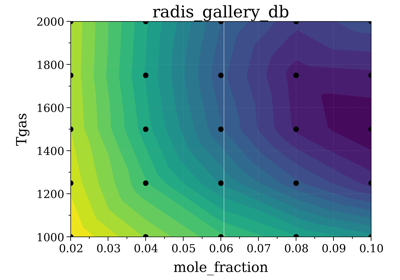
Example #7: Database fitting using SpecDatabase.fit_spectrum
Example #7: Database fitting using SpecDatabase.fit_spectrum
- load_databank(name=None, path=None, format: ['hitran', 'hitemp', 'cdsd-hitemp', 'cdsd-4000', 'hitemp-radisdb', 'hdf5-radisdb', 'geisa', 'exomol-radisdb'] = None, parfunc=None, levels=None, levelsfmt: ['radis', 'cdsd-pc', 'cdsd-pcN', 'cdsd-hamil', None] = None, db_use_cached=True, lvl_use_cached=True, load_energies=False, include_neighbouring_lines=True, drop_columns='auto', load_columns='equilibrium')[source]
Loads databank from shortname in the Configuration file. (
json), or by manually setting all attributes.Databank includes: - lines - partition function & format (tabulated or calculated) - (optional) energy levels, format
- Parameters:
name (a section name specified in your
~/radis.json) –.radishas to be created in your HOME (Unix) / User (Windows). If notNone, all other arguments are discarded. Note that all files in database will be loaded and it may takes some time. Better limit the database size if you already know what range you need. See Configuration file andDBFORMATfor expected~/radis.jsonformat- Other Parameters:
path (str, list of str, None) – list of database files, or name of a predefined database in the Configuration file (
json) Accepts wildcards*to select multiple filesformat (
'hitran','cdsd-hitemp','cdsd-4000', or any ofKNOWN_DBFORMAT) – database type.'hitran'for HITRAN/HITEMP,'cdsd-hitemp'and'cdsd-4000'for the different CDSD versions. Default'hitran'parfunc (filename or None) – path to tabulated partition function to use.
If not given, then the hapi.py embedded in RADIS is used (check version). This argument only affects molecules.
levels (dict of str or None) – path to energy levels (needed for non-eq calculations). Format: {1:path_to_levels_iso_1, 3:path_to_levels_iso3}. Default
None. This argument only affects molecules.levelsfmt (‘cdsd-pc’, ‘radis’ (or any of
KNOWN_LVLFORMAT) orNone) – how to read the previous file. Known formats: (seeKNOWN_LVLFORMAT). Ifradis, energies are calculated using the diatomic constants in radis.db database if available for given molecule. Look up references there. IfNone, non equilibrium calculations are not possible. Default'radis'. This argument only affects molecules.db_use_cached (boolean, or
None) – ifTrue, a pandas-readable csv file is generated on first access, and later used. This saves on the datatype cast and conversion and improves performances a lot. But! … be sure to delete these files to regenerate them if you happen to change the database. If'regen', existing cached files are removed and regenerated. It is also used to load energy levels from.h5cache file if exist. IfNone, the value given on Factory creation is used. DefaultTrueload_energies (boolean) – if
False, dont load energy levels. This means that nonequilibrium spectra cannot be calculated, but it saves some memory. DefaultTrueThis argument only affects molecules.include_neighbouring_lines (bool) –
True, includes off-range, neighbouring lines that contribute because of lineshape broadening. Theneighbour_linesparameter is used to determine the limit. DefaultTrue.**Other arguments are related to how to open the files (****)
drop_columns (list) – columns names to drop from Line DataFrame after loading the file. Not recommended to use, unless you explicitly want to drop information (for instance if dealing with too large databases). If
[], nothing is dropped. If'auto', parameters considered useless are dropped. Seedrop_auto_columns_for_dbformatanddrop_auto_columns_for_levelsfmt. If'all', parameters considered unnecessary for equilibrium calculations are dropped, including all information about lines that could be otherwise available inSpectrum()method. Warning: nonequilibrium calculations are not possible in this mode. Default'auto'.load_columns (list,
'all','equilibrium','noneq') – columns names to load. If'equilibrium', only load the columns required for equilibrium calculations. If'noneq', also load the columns required for non-LTE calculations. Seedrop_all_but_these. If'all', load everything. Note that for performances, it is better to load only certain columns rather than loading them all and dropping them withdrop_columns. Default'equilibrium'.Warning
if using
'equilibrium', not all parameters will be available for a Spectrumline_survey().
See also
Only load when needed:
init_databank()Download from HITRAN:
fetch_databank()
Configuration file with: - all line database formats:
DBFORMAT- all energy levels database formats:LVLFORMATReferences
- misc[source]
Miscellaneous parameters (
MiscParams) params that cannot change the output of calculations (ex: number of CPU, etc.)
- molparam[source]
contains information about molar mass; isotopic abundance.
See
MolParams- Type:
MolParam
- params[source]
Parametersthey may change the output of calculations (ex: threshold, cutoff, broadening methods, etc.)- Type:
Computational parameters
- save_memory[source]
if True, tries to save RAM memory (but may take a little for time, saving stuff to files instead of RAM for instance)
- Type:
bool
- set_abundance(molecule, isotope, abundance)[source]
Set isotopic abundance
- Parameters:
molecule (str)
isotope (int, or list) – isotope number, sorted in terrestrial abundance
abundance (float, or list)
Examples
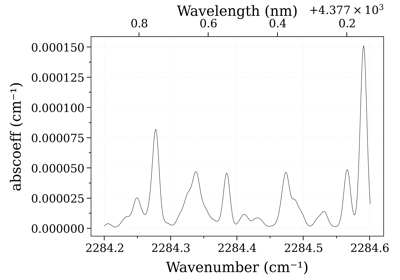
from radis import SpectrumFactory

sf = SpectrumFactory(
    2284.2,
    2284.6,
    wstep=0.001,  # cm-1
    pressure=20 * 1e-3,  # bar
    mole_fraction=400e-6,
    molecule="CO2",
    isotope="1,2",
    verbose=False
)
sf.load_databank("HITEMP-CO2-TEST")
print("Abundance of CO2[1,2]", sf.get_abundance("CO2", [1, 2]))
sf.eq_spectrum(2000).plot("abscoeff")

#%% Set the abundance of CO2(626) to 0.8; and the abundance of CO2(636) to 0.2 (arbitrary):
sf.set_abundance("CO2", [1, 2], [0.8, 0.2])
print("New abundance of CO2[1,2]", sf.get_abundance("CO2", [1, 2]))

sf.eq_spectrum(2000).plot("abscoeff", nfig="same")
See also
- set_atomic_partition_functions(pfsource=None)[source]
Construct an interpolator or calculator for atomic partition functions and store it in the
parsumattribute- Parameters:
pfsource (
string) – The source for the partition function tables for an interpolator or energy level tables for a calculator. Sources implemented so far are ‘barklem’ and ‘kurucz’ for the former, and ‘nist’ for the latter. ‘default’ is currently ‘nist’.
- warn(message, category='default', level=0)[source]
Trigger a warning, an error or just ignore based on the value defined in the
warningsdictionary. The warnings can thus be deactivated selectively by setting the SpectrumFactorywarningsattribute- Parameters:
message (str) – what to print
category (str) – one of the keys of self.warnings. See
warningslevel (int) – warning level. Only print warnings when verbose level is higher than the warning levels. i.e., warnings of level 1 appear only if
verbose==True, warnings of level 2 appear only forverbose>=2, etc.. Warnings of level 0 appear only the time. Default0
Examples
- ::
- if not ((df.Erotu > tol).all() and (df.Erotl > tol).all()):
- self.warn(
“There are negative rotational energies in the database”, “NegativeEnergiesWarning”,
)
Notes
All warnings in the SpectrumFactory should call to this method rather than the default warnings.warn() method, because it allows easier runtime modification of how to deal with warnings
See also
- class Input[source]
Bases:
ConditionDictHolds Spectrum calculation input conditions, under the attribute
inputofSpectrumFactory. Works like a dict except you can also access attribute with:v = sf.input.key # equivalent to v = sf.input[key]
- KNOWN_DBFORMAT = ['hitran', 'hitemp', 'cdsd-hitemp', 'cdsd-4000', 'hitemp-radisdb', 'hdf5-radisdb', 'geisa', 'exomol-radisdb'][source]
Known formats for Line Databases:
'hitran': [HITRAN-2020] original .par format.'hitemp': [HITEMP-2010] original format (same format as ‘hitran’).'cdsd-hitemp': CDSD-HITEMP original format (CO2 only, same lines as HITEMP-2010).'cdsd-4000': [CDSD-4000] original format (CO2 only).'hitemp-radisdb': HITEMP under RADISDB format (pytables-HDF5 with RADIS column names).'hdf5-radisdb': arbitrary HDF5 file with RADIS column names.'geisa': [GEISA-2020] original .par format.
To install all databases manually see the Configuration file and the list of databases .
See also
- Type:
list
- KNOWN_LVLFORMAT = ['radis', 'cdsd-pc', 'cdsd-pcN', 'cdsd-hamil', None][source]
Known formats for Energy Level Databases (used in non-equilibrium calculations):
'radis': energies calculated with Dunham expansions by
'cdsd-pc': energies read from precomputed CDSD energies for CO2, withviblvl=(p,c)convention. SeePartFuncCO2_CDSDcalc
'cdsd-pcN': energies read from precomputed CDSD energies for CO2, withviblvl=(p,c,N)convention. SeePartFuncCO2_CDSDcalc
'cdsd-hamil': energies read from precomputed CDSD energies for CO2, withviblvl=(p,c,J,N)convention, i.e., a each rovibrational level can have a unique vibrational energy (this is needed when taking account Coupling terms) SeePartFuncCO2_CDSDcalc
None: means you can only do Equilibrium calculations.
See also
- Type:
list
- KNOWN_PARFUNCFORMAT = ['cdsd', 'hapi'][source]
Known formats for partition function (tabulated files to read), or ‘hapi’ to fetch Partition Functions using HITRAN Python interface instead of reading a tabulated file.
See also
- Type:
list
- class MiscParams[source]
Bases:
ConditionDictA class to hold Spectrum calculation descriptive parameters, under the attribute
paramsofSpectrumFactory. UnlikeParameters, these parameters cannot influence the Spectrum output and will not be used when comparing Spectrum with existing, precomputed spectra inSpecDatabaseWorks like a dict except you can also access attribute with:v = a.key
- class Parameters[source]
Bases:
ConditionDictHolds Spectrum calculation computation parameters, under the attribute
paramsofSpectrumFactory. Works like a dict except you can also access attribute with:v = sf.params.key # equivalent to v = sf.params[key]
Also can be copied, deepcopied, and parallelized in multiprocessing
- dbformat[source]
format of Line Database. See
KNOWN_DBFORMAT- Type:
str
- include_neighbouring_lines[source]
if
True, includes the contribution of off-range, neighbouring lines because of lineshape broadening. DefaultTrue.- Type:
bool
- levelsfmt[source]
format of Energy Database. See
KNOWN_LVLFORMAT- Type:
str
- neighbour_lines[source]
extra range (cm-1) on each side of the spectrum to account for neighbouring lines. Overwritten by SpectrumFactory
- Type:
float
- parsum_mode[source]
“full summation” or “tabulation” . calculation mode of partition function. See
RovibParFuncCalculator- Type:
int
- pseudo_continuum_threshold[source]
threshold to assign lines in pseudo continuum. Overwritten in SpectrumFactory
- Type:
float
- sparse_ldm[source]
“auto”, True, False . Sparse LDM calculation. See
radis.lbl.broadening.BroadenFactory._apply_lineshape_LDM()- Type:
str
- truncation[source]
cutoff for half-width lineshape calculation (cm-1). Overwritten by SpectrumFactory
- Type:
float
- wavenum_max_calc[source]
maximum calculated wavenumber (cm-1) initialized by SpectrumFactory
- Type:
float
- broadening_coeff = ['gamma_co2', 'n_co2', 'gamma_h2o', 'n_h2o', 'gamma_he', 'n_he', 'gamma_h2', 'n_h2'][source]
column names required for non-air diluent calculations.
- Type:
list
- df_metadata = ['molecule', 'iso', 'id', 'Ia', 'molar_mass', 'Qref', 'Qvib', 'Q', 'id', 'id', 'iso', 'iso', 'iso', 'iso', 'iso', 'iso', 'iso', 'id', 'iso', 'id', 'iso', 'id', 'iso', 'id', 'iso', 'id', 'iso', 'id', 'iso', 'id', 'iso', 'id', 'iso', 'id', 'iso', 'id', 'iso', 'id', 'iso', 'id', 'iso', 'id', 'iso', 'id', 'iso', 'id', 'iso', 'id', 'iso', 'id', 'iso', 'id', 'iso', 'id', 'iso', 'id', 'iso', 'id', 'iso', 'id', 'iso', 'id', 'iso', 'id', 'iso', 'id', 'iso', 'id', 'iso', 'id', 'iso', 'id', 'iso', 'id', 'iso', 'id', 'iso', 'id', 'iso', 'id', 'iso', 'id', 'iso', 'id', 'iso', 'id', 'iso', 'id', 'iso', 'id', 'iso', 'id', 'iso', 'id', 'iso', 'id', 'iso', 'id', 'iso', 'id', 'iso', 'id', 'iso', 'id', 'iso', 'id', 'iso', 'id', 'iso', 'id', 'iso', 'id', 'iso', 'id', 'iso', 'id', 'iso', 'id', 'iso', 'id', 'iso', 'id', 'iso', 'id', 'iso', 'id', 'iso', 'id', 'iso', 'id', 'iso', 'id', 'iso', 'id', 'iso', 'id', 'iso', 'id', 'iso', 'id', 'iso', 'id', 'iso', 'id', 'id', 'id', 'id', 'iso', 'id', 'iso', 'id', 'id', 'id', 'id', 'id', 'id', 'iso', 'id', 'id', 'iso', 'id', 'iso', 'id', 'id', 'iso', 'id', 'id', 'iso', 'id', 'id', 'id', 'iso', 'id', 'id', 'id', 'id', 'iso', 'id'][source]
metadata of line DataFrames
df0,df1. @dev: when having only 1 molecule, 1 isotope, these parameters are constant for all rovibrational lines. Thus, it’s faster and much more memory efficient to transport them as attributes of the DataFrame rather than columns. The syntax is the same, thus the operations do not change, i.e:k_b / df.molar_mass
will work whether molar_mass is a float or a column.
Warning
However, in the current Pandas implementation of
DataFrame, attributes are lost whenever the DataFrame is recreated, transposed, pickled.Thus, we use
transfer_metadata()to keep the attributes after an operation, andexpand_metadata()to make them columns before a Serializing operation (ex: multiprocessing) @dev: all of that is a high-end optimization. Users should not deal with internal DataFrames.References
https://stackoverflow.com/q/13250499/5622825
- Type:
list
- drop_all_but_these = ['id', 'iso', 'wav', 'int', 'A', 'airbrd', 'selbrd', 'Tdpair', 'Tdpsel', 'Pshft', 'El', 'gp'][source]
drop all columns but these if using
drop_columns='all'in load_databank Note: nonequilibrium calculations wont be possible anymore and it wont be possible to identify lines withline_survey()See also
-,-,-- Type:
list
- drop_auto_columns_for_dbformat = {'cdsd-4000': ['wang2'], 'cdsd-hitemp': ['wang2', 'lsrc'], 'exomol-radisdb': [], 'geisa': [], 'hdf5-radisdb': [], 'hitemp': ['ierr', 'iref', 'lmix', 'gpp'], 'hitemp-radisdb': [], 'hitran': ['ierr', 'iref', 'lmix', 'gpp']}[source]
drop these columns if using
drop_columns='auto'in load_databank Based on the value ofdbformat=, some of these columns won’t be used.See also
-,-,-,-- Type:
dict
- drop_auto_columns_for_levelsfmt = {'cdsd-hamil': ['v1u', 'v2u', 'l2u', 'v3u', 'ru', 'v1l', 'v2l', 'l2l', 'v3l', 'rl'], 'cdsd-pc': ['v1u', 'v2u', 'l2u', 'v3u', 'ru', 'v1l', 'v2l', 'l2l', 'v3l', 'rl'], 'cdsd-pcN': ['v1u', 'v2u', 'l2u', 'v3u', 'ru', 'v1l', 'v2l', 'l2l', 'v3l', 'rl'], 'radis': [], None: []}[source]
drop these columns if using
drop_columns='auto'in load_databank Based on the value oflvlformat=, some of these columns won’t be used.See also
-,-,-,-- Type:
dict