




Legacy vs recommended fitting examples
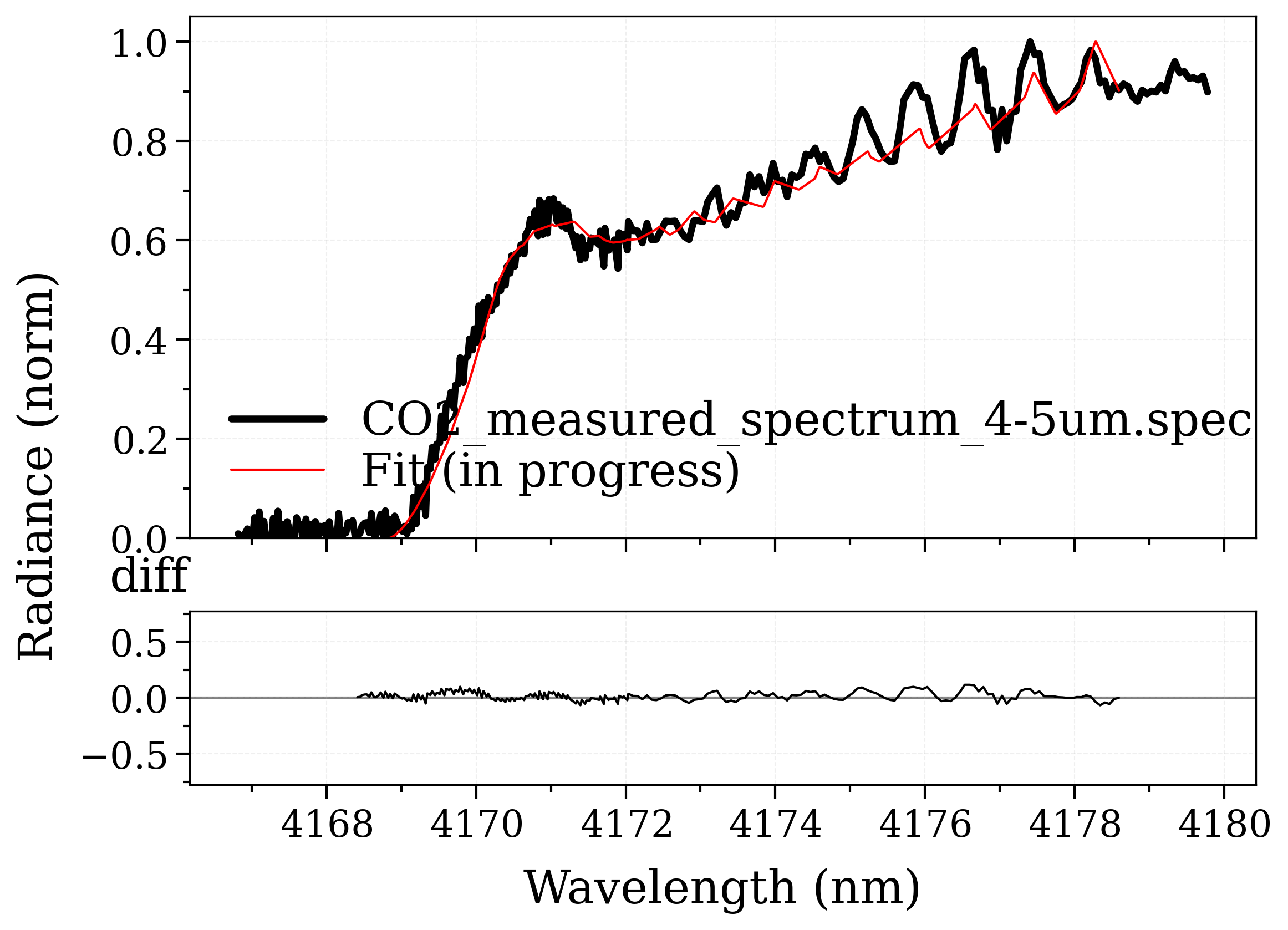
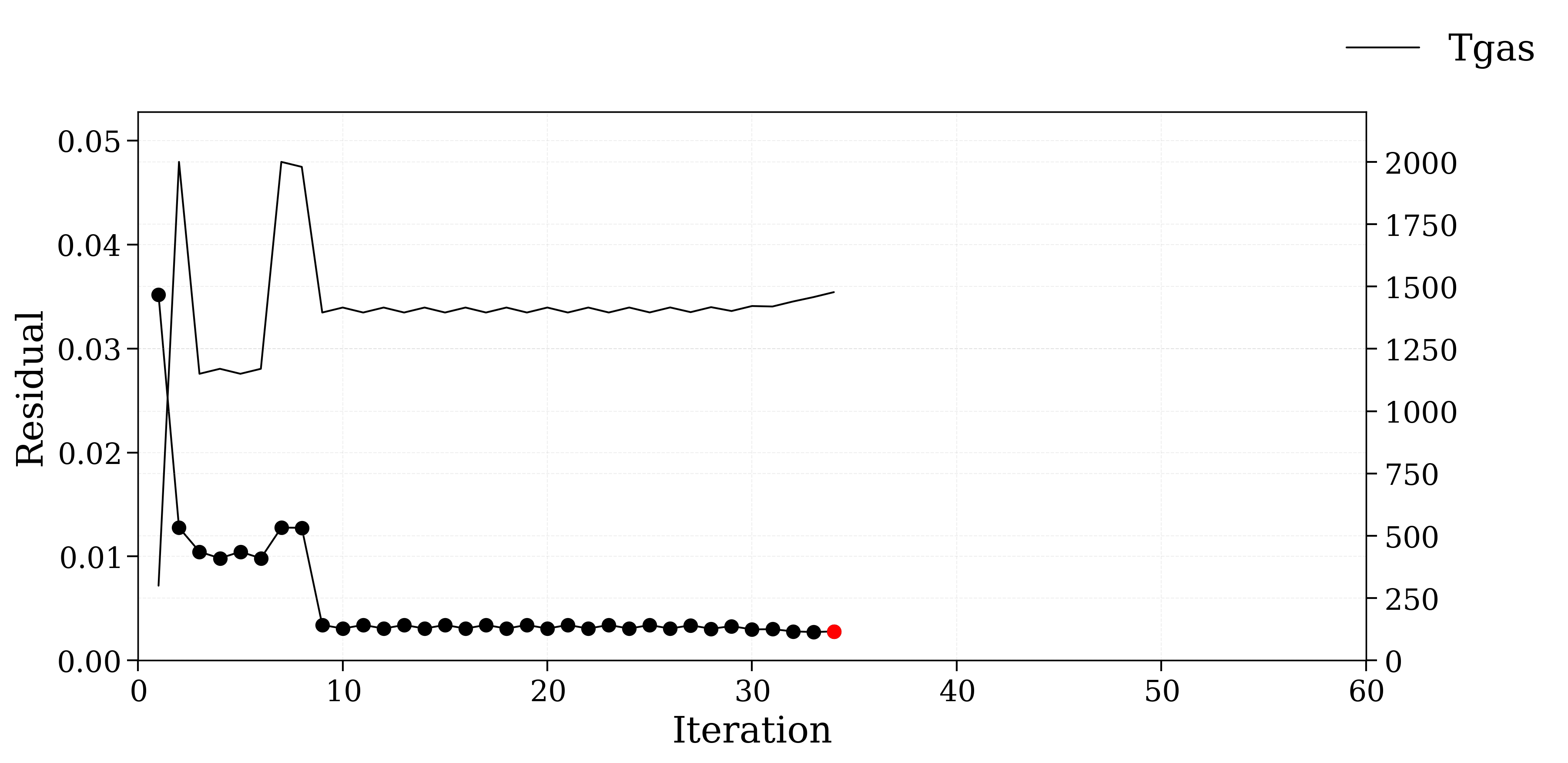
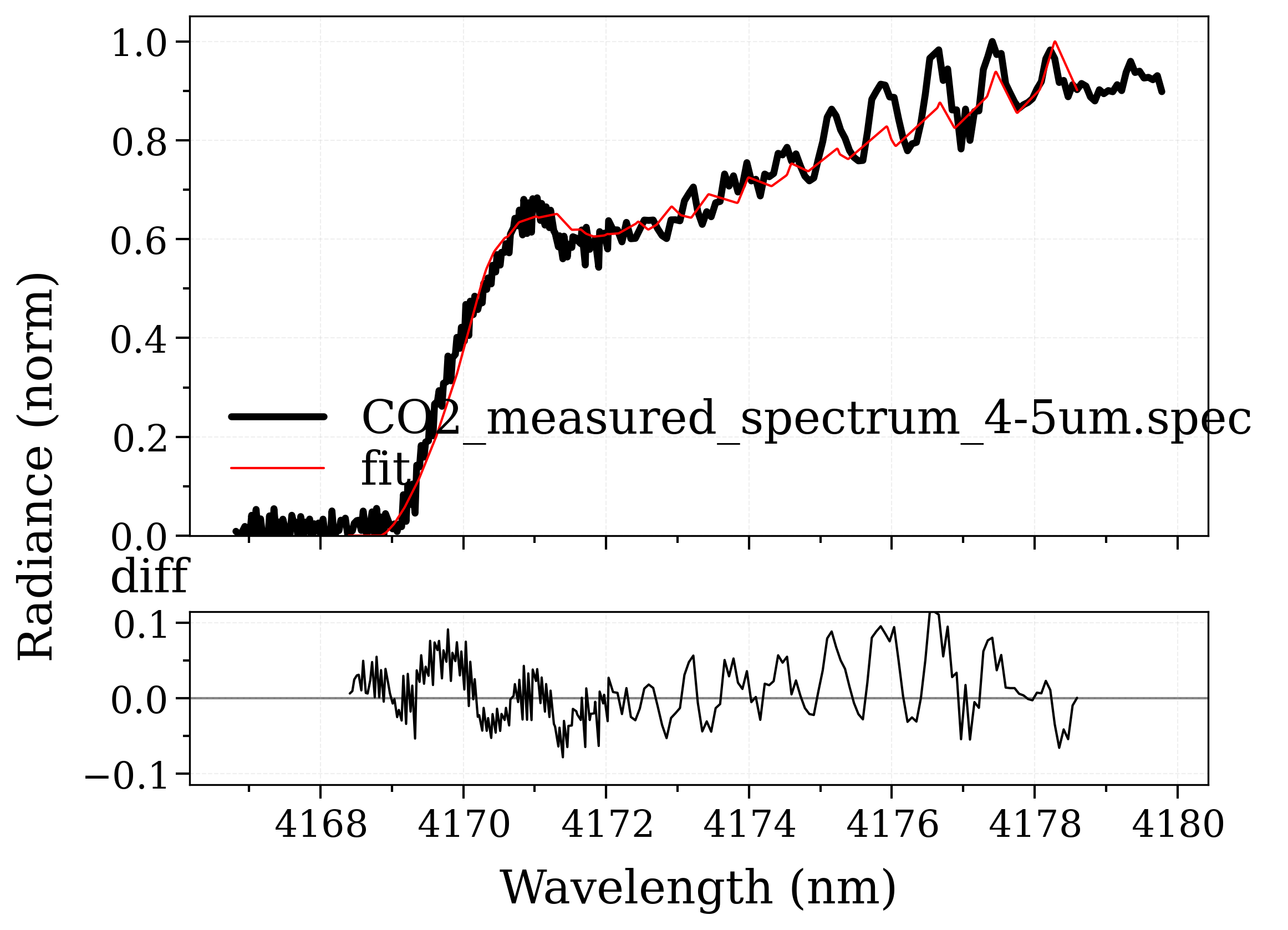
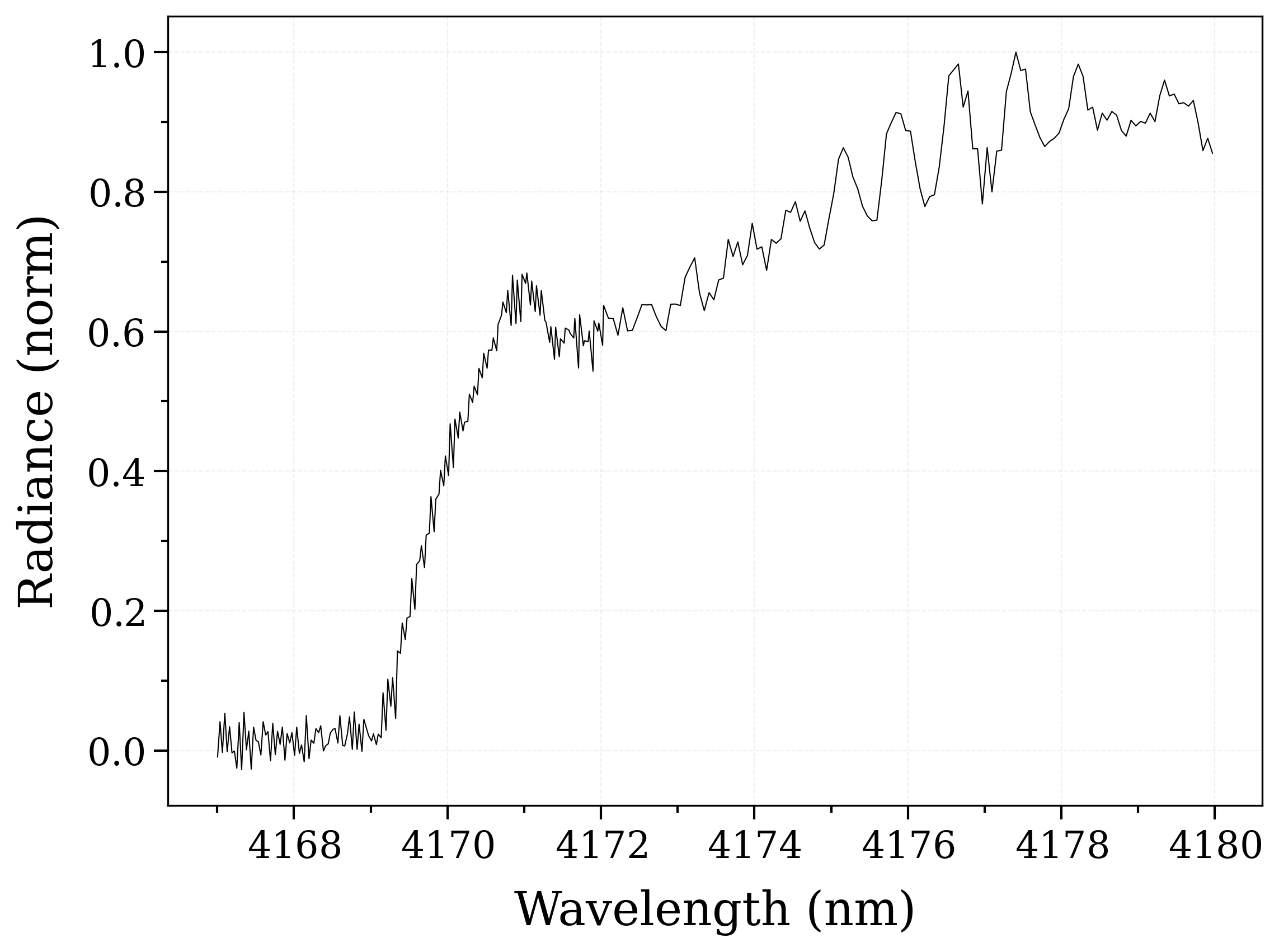
In this example, an experimental spectrum is fit using two fitting pipelines:
Legacy fitting module of
fit_spectrum(). You can find the gallery example featuring it at1 temperature fit.New fitting module of
fit_spectrum(), a new fitting interface for a more practical and interactive fitting experience. See1 temperature fit using new module
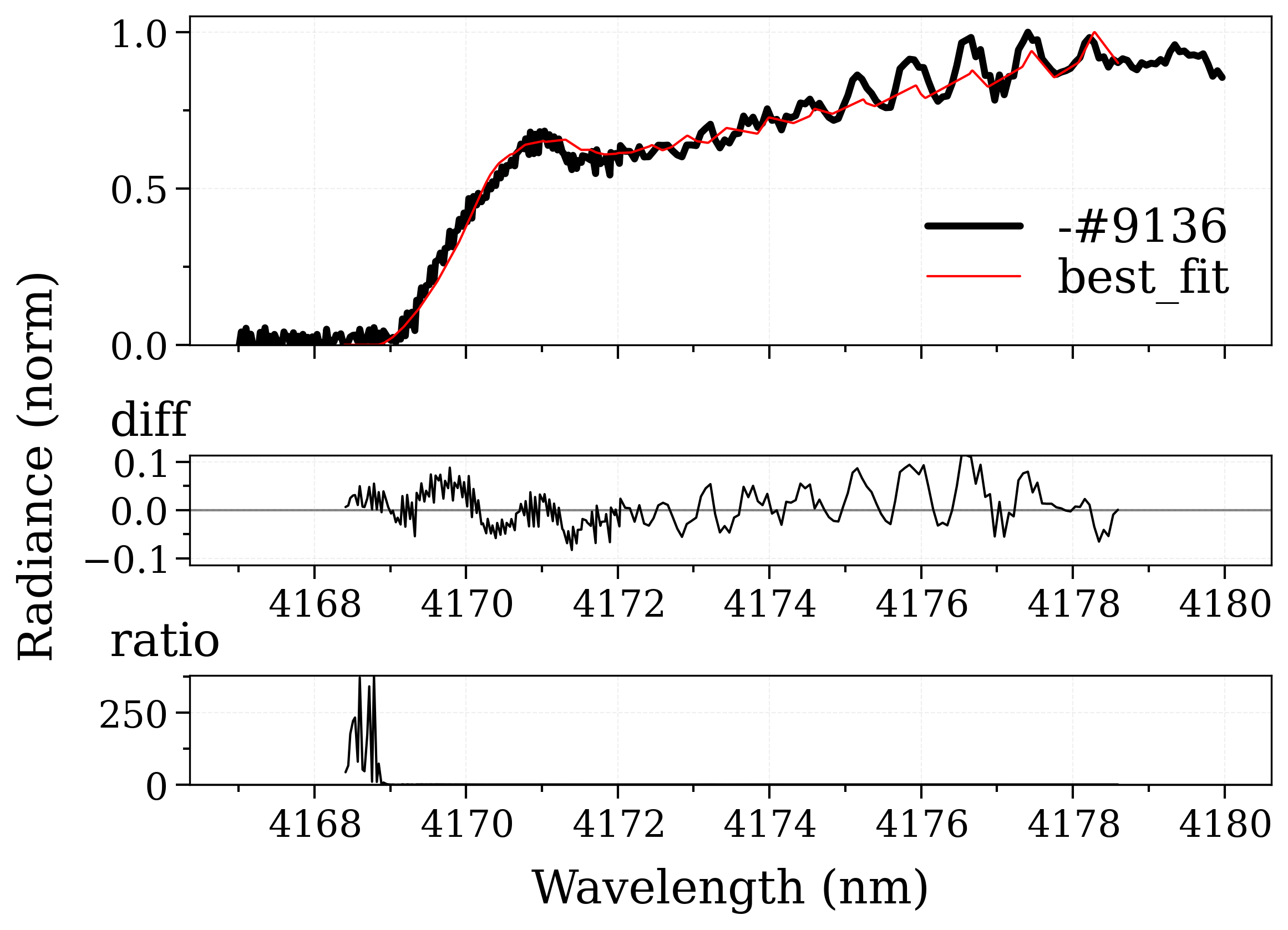
THe present code compare their overall performance, including number of loops, fitting time, and final residuals between experimental and best-fit spectra, as an indicator of fit accuracy.
Using database: HITRAN-CO2-TEST
'HITRAN-CO2-TEST':
{'info': 'HITRAN 2016 database, CO2, 1 main isotope (CO2-626), bandhead: 2380-2398 cm-1 (4165-4200 nm)', 'path': ['/home/docs/checkouts/readthedocs.org/user_builds/radis/checkouts/latest/radis/test/files/hitran_co2_626_bandhead_4165_4200nm.par'], 'format': 'hitran', 'levelsfmt': 'radis'}


Reference databank (2391.79-2399.14cm-1) has 0 lines in range (2391.69-2399.15cm-1) for isotope 2. Change your range or isotope options

/home/docs/checkouts/readthedocs.org/user_builds/radis/checkouts/latest/radis/misc/log.py:51: UserWarning: Reference databank (2391.79-2399.14cm-1) has 0 lines in range (2391.69-2399.15cm-1) for isotope 2. Change your range or isotope options
  warn(msg)
0.03s - Loaded database
/home/docs/checkouts/readthedocs.org/user_builds/radis/checkouts/latest/radis/misc/warning.py:443: LinestrengthCutoffWarning: Estimated error after discarding lines is large: 0.07%. Consider reducing cutoff
  warnings.warn(WarningType(message))
Calculating Equilibrium Spectrum
Physical Conditions
----------------------------------------
   Tgas                 300 K
   isotope              1,2
   medium               air
   mole_fraction        1
   path_length          10 cm
   pressure             0.001 bar
   self_absorption      True
   species              CO2
   state                X
   wavenum_max          2399.1537 cm-1
   wavenum_min          2391.6923 cm-1
Computation Parameters
----------------------------------------
   Tref                 296 K
   add_at_used          numpy
   broadening_method    voigt_poly
   cutoff               1e-25 cm-1/(#.cm-2)
   dbformat             hitran
   dbpath               /home/docs/checkouts/readthedocs.org/user_builds/radis/checkouts/latest/radis/test/files/hitran_co2_...
   diluent              air
   folding_thresh       1e-06
   include_neighbouring_lines  True
   isatom               False
   isneutral            None
   lbfunc               None
   memory_mapping_engine  auto
   neighbour_lines      0 cm-1
   optimization         simple
   parsum_mode          full summation
   pfsource             default
   potential_lowering   None
   pseudo_continuum_threshold  0
   sparse_ldm           True
   truncation           1 cm-1
   waveunit             cm-1
   wstep                0.001 cm-1
   zero_padding         7463
----------------------------------------
0.02s - Spectrum calculated
/home/docs/checkouts/readthedocs.org/user_builds/radis/checkouts/latest/radis/misc/warning.py:443: LinestrengthCutoffWarning: Estimated error after discarding lines is large: 0.07%. Consider reducing cutoff
  warnings.warn(WarningType(message))
/home/docs/checkouts/readthedocs.org/user_builds/radis/checkouts/latest/radis/misc/warning.py:443: LinestrengthCutoffWarning: Estimated error after discarding lines is large: 0.07%. Consider reducing cutoff
  warnings.warn(WarningType(message))

Now starting the fitting process:
---------------------------------

/home/docs/checkouts/readthedocs.org/user_builds/radis/checkouts/latest/radis/tools/fitting.py:480: OptimizeWarning: Unknown solver options: disp
  best = minimize(
Tgas=1150.0, Residual: 0.0105 🏆
Tgas=1170.0, Residual: 0.0098 🏆
Tgas=1150.0, Residual: 0.0105
Tgas=1170.0, Residual: 0.0098 🏆
Tgas=2000.0, Residual: 0.0128
Tgas=1980.0, Residual: 0.0128
Tgas=1396.0, Residual: 0.0034 🏆
Tgas=1416.0, Residual: 0.0031 🏆
Tgas=1396.0, Residual: 0.0034
Tgas=1416.0, Residual: 0.0031 🏆
Tgas=1396.0, Residual: 0.0034
Tgas=1416.0, Residual: 0.0031 🏆
Tgas=1396.0, Residual: 0.0034
Tgas=1416.0, Residual: 0.0031 🏆
Tgas=1396.0, Residual: 0.0034
Tgas=1416.0, Residual: 0.0031 🏆
Tgas=1396.0, Residual: 0.0034
Tgas=1416.0, Residual: 0.0031 🏆
Tgas=1396.0, Residual: 0.0034
Tgas=1416.0, Residual: 0.0031 🏆
Tgas=1396.0, Residual: 0.0034
Tgas=1416.0, Residual: 0.0031 🏆
Tgas=1396.0, Residual: 0.0034
Tgas=1416.0, Residual: 0.0031 🏆
Tgas=1397.0, Residual: 0.0034
Tgas=1417.0, Residual: 0.0031 🏆
Tgas=1402.0, Residual: 0.0033
Tgas=1422.0, Residual: 0.0030 🏆
Tgas=1420.0, Residual: 0.0030
Tgas=1440.0, Residual: 0.0028 🏆
Tgas=1459.0, Residual: 0.0027 🏆
Tgas=1479.0, Residual: 0.0028
Init ['Tgas'] = [1150.]['']
Final ['Tgas'] = [1459.]['']
  message: CONVERGENCE: NORM OF PROJECTED GRADIENT <= PGTOL
  success: True
   status: 0
      fun: 0.0027304260508692786
        x: [ 1.459e+03]
      nit: 4
      jac: [ 3.330e-06]
     nfev: 32
     njev: 16
 hess_inv: <1x1 LbfgsInvHessProduct with dtype=float64>
Best ['Tgas'] = [1458.71148816][''] reached at iteration 32/32
0.04s - Loaded database
/home/docs/checkouts/readthedocs.org/user_builds/radis/checkouts/latest/radis/misc/curve.py:267: UserWarning: First spectrum has more resolution than 2nd. Reverse your spectra in interpolation/comparison for a better accuracy
  warnings.warn(
/home/docs/checkouts/readthedocs.org/user_builds/radis/checkouts/latest/radis/misc/curve.py:267: UserWarning: First spectrum has more resolution than 2nd. Reverse your spectra in interpolation/comparison for a better accuracy
  warnings.warn(
/home/docs/checkouts/readthedocs.org/user_builds/radis/checkouts/latest/radis/misc/curve.py:267: UserWarning: First spectrum has more resolution than 2nd. Reverse your spectra in interpolation/comparison for a better accuracy
  warnings.warn(
/home/docs/checkouts/readthedocs.org/user_builds/radis/checkouts/latest/radis/misc/curve.py:267: UserWarning: First spectrum has more resolution than 2nd. Reverse your spectra in interpolation/comparison for a better accuracy
  warnings.warn(
/home/docs/checkouts/readthedocs.org/user_builds/radis/checkouts/latest/radis/misc/curve.py:267: UserWarning: First spectrum has more resolution than 2nd. Reverse your spectra in interpolation/comparison for a better accuracy
  warnings.warn(
/home/docs/checkouts/readthedocs.org/user_builds/radis/checkouts/latest/radis/misc/curve.py:267: UserWarning: First spectrum has more resolution than 2nd. Reverse your spectra in interpolation/comparison for a better accuracy
  warnings.warn(
/home/docs/checkouts/readthedocs.org/user_builds/radis/checkouts/latest/radis/misc/curve.py:267: UserWarning: First spectrum has more resolution than 2nd. Reverse your spectra in interpolation/comparison for a better accuracy
  warnings.warn(
/home/docs/checkouts/readthedocs.org/user_builds/radis/checkouts/latest/radis/misc/curve.py:267: UserWarning: First spectrum has more resolution than 2nd. Reverse your spectra in interpolation/comparison for a better accuracy
  warnings.warn(
/home/docs/checkouts/readthedocs.org/user_builds/radis/checkouts/latest/radis/misc/curve.py:267: UserWarning: First spectrum has more resolution than 2nd. Reverse your spectra in interpolation/comparison for a better accuracy
  warnings.warn(
/home/docs/checkouts/readthedocs.org/user_builds/radis/checkouts/latest/radis/misc/curve.py:267: UserWarning: First spectrum has more resolution than 2nd. Reverse your spectra in interpolation/comparison for a better accuracy
  warnings.warn(
/home/docs/checkouts/readthedocs.org/user_builds/radis/checkouts/latest/radis/misc/curve.py:267: UserWarning: First spectrum has more resolution than 2nd. Reverse your spectra in interpolation/comparison for a better accuracy
  warnings.warn(
/home/docs/checkouts/readthedocs.org/user_builds/radis/checkouts/latest/radis/misc/curve.py:267: UserWarning: First spectrum has more resolution than 2nd. Reverse your spectra in interpolation/comparison for a better accuracy
  warnings.warn(
/home/docs/checkouts/readthedocs.org/user_builds/radis/checkouts/latest/radis/misc/curve.py:267: UserWarning: First spectrum has more resolution than 2nd. Reverse your spectra in interpolation/comparison for a better accuracy
  warnings.warn(
/home/docs/checkouts/readthedocs.org/user_builds/radis/checkouts/latest/radis/misc/curve.py:267: UserWarning: First spectrum has more resolution than 2nd. Reverse your spectra in interpolation/comparison for a better accuracy
  warnings.warn(
/home/docs/checkouts/readthedocs.org/user_builds/radis/checkouts/latest/radis/misc/curve.py:267: UserWarning: First spectrum has more resolution than 2nd. Reverse your spectra in interpolation/comparison for a better accuracy
  warnings.warn(
/home/docs/checkouts/readthedocs.org/user_builds/radis/checkouts/latest/radis/misc/curve.py:267: UserWarning: First spectrum has more resolution than 2nd. Reverse your spectra in interpolation/comparison for a better accuracy
  warnings.warn(
/home/docs/checkouts/readthedocs.org/user_builds/radis/checkouts/latest/radis/misc/curve.py:267: UserWarning: First spectrum has more resolution than 2nd. Reverse your spectra in interpolation/comparison for a better accuracy
  warnings.warn(
[[Fit Statistics]]
    # fitting method   = L-BFGS-B
    # function evals   = 16
    # data points      = 1
    # variables        = 1
    chi-square         = 2.6824e-07
    reduced chi-square = 2.6824e-07
    Akaike info crit   = -13.1313719
    Bayesian info crit = -15.1313719
##  Warning: uncertainties could not be estimated:
    this fitting method does not natively calculate uncertainties
    and numdifftools is not installed for lmfit to do this. Use
    `pip install numdifftools` for lmfit to estimate uncertainties
    with this fitting method.
[[Variables]]
    Tgas:  1464.94931 (init = 1150)
/home/docs/checkouts/readthedocs.org/user_builds/radis/checkouts/latest/radis/misc/curve.py:240: UserWarning: Presence of NaN in curve_divide!
Think about interpolation=2
  warnings.warn(


====================  PERFORMANCE COMPARISON BETWEEN 2 FITTING METHODS  ====================

1. LAST RESIDUAL

- Old 1T fitting example:       0.0027304260508692786
- New fitting module:           0.000517921976887822

2. NUMBER OF FITTING LOOPS

- Old 1T fitting example:       32 loops
- New fitting module:           16 loops

3. TOTAL TIME TAKEN (s)

- Old 1T fitting example:       1.5065557956695557 s
- New fitting module:           2.5874476432800293 s

==========================================================================================


'\n\nFrom the comparative result above, which includes last residual, total time fitting and total number of\nfitting loops of each fitting method, we can see that under exactly the same ground-truth conditions,\nfitting method (L-BFGS-B) and fitting pipeline, we can see that the new fitting module provides a better\naccuracy, while requiring less fitting loops and time for execution.\n\nYou are free to change the experimental spectrum and its accompanied ground-truth conditions, but please\nmake sure to keep the same inputs between the two for a transparent comparative result.\n\n'
import time

import astropy.units as u

from radis import SpectrumFactory, load_spec, plot_diff
from radis.test.utils import getTestFile, setup_test_line_databases
from radis.tools.fitting import LTEModel
from radis.tools.new_fitting import fit_spectrum

# -------------------- OLD 1-TEMPERATURE FITTING EXAMPLE -------------------- #

setup_test_line_databases()

# fit range
wlmin = 4167
wlmax = 4180

s_exp = (
    load_spec(getTestFile("CO2_measured_spectrum_4-5um.spec"))
    .crop(wlmin, wlmax, "nm")
    .normalize()
    .sort()
    .offset(-0.2, "nm")
)


def LTEModel_withslitnorm(factory, fit_parameters, fixed_parameters):
    s = LTEModel(factory, fit_parameters, fixed_parameters)
    # we could also have added a fittable parameter, such as an offset,
    # or made the slit width a fittable parameter.
    # ... any parameter in model_input will be fitted.
    # s.offset(model_input["offset"], 'nm')
    s.apply_slit(1.4, "nm")
    return s.take("radiance").normalize()


sf = SpectrumFactory(
    wlmin * u.nm,
    wlmax * u.nm,
    wstep=0.001,  # cm-1
    pressure=1 * 1e-3,  # bar
    cutoff=1e-25,
    isotope="1,2",
    path_length=10,  # cm-1
    mole_fraction=1,
    truncation=1,  # cm-1
)
sf.warnings["MissingSelfBroadeningWarning"] = "ignore"
sf.warnings["HighTemperatureWarning"] = "ignore"
sf.load_databank("HITRAN-CO2-TEST")

begin_time_mark = time.time()

s_best, best = sf.fit_legacy(
    s_exp.take("radiance"),
    model=LTEModel_withslitnorm,
    fit_parameters={
        "Tgas": 300,
        # "offset": 0
    },
    bounds={
        "Tgas": [300, 2000],
        # "offset": [-1, 1],
    },
    plot=True,
    solver_options={
        "maxiter": 15,  # 👈 increase to let the fit converge
        "ftol": 1e-15,
    },
    verbose=2,
)

end_time_mark = time.time()

plot_diff(s_exp, s_best)

# Information to report later in comparison result
oldfitting_residual = best.fun
oldfitting_loops = best.nfev
oldfitting_time = end_time_mark - begin_time_mark

# ------------------------------------------------------------ #


# ---------------------------- NEW FITTING MODULE ---------------------------- #


# -------------------- Step 1. Load experimental spectrum -------------------- #


# Load an experimental spectrum. You can prepare yours, or fetch one of them in the radis/test/files directory.
my_spec = getTestFile("CO2_measured_spectrum_4-5um.spec")
s_experimental = load_spec(my_spec).offset(-0.2, "nm")


# -------------------- Step 2. Fill ground-truths and data -------------------- #


# Experimental conditions which will be used for spectrum modeling. Basically, these are known ground-truths.
experimental_conditions = {
    "molecule": "CO2",  # Molecule ID
    "isotope": "1,2",  # Isotope ID, can have multiple at once
    "wmin": 4167
    * u.nm,  # Starting wavelength/wavenumber to be cropped out from the original experimental spectrum.
    "wmax": 4180 * u.nm,  # Ending wavelength/wavenumber for the cropping range.
    "mole_fraction": 1,  # Species mole fraction, from 0 to 1.
    "pressure": 1
    * 1e-3
    * u.bar,  # Total pressure of gas, in "bar" unit by default, but you can also use Astropy units.
    "path_length": 10
    * u.cm,  # Experimental path length, in "cm" unit by default, but you can also use Astropy units.
    "slit": "1.4 nm",  # Experimental slit, must be a blank space separating slit amount and unit.
    "wstep": 0.001,  # Resolution of wavenumber grid, in cm-1.
    "databank": "hitran",  # Databank used for the spectrum calculation. Must be stated.
}

# List of parameters to be fitted, accompanied by their initial values.
fit_parameters = {
    "Tgas": 1150,  # Gas temperature, in K.
}

# List of bounding ranges applied for those fit parameters above.
# You can skip this step and let it use default bounding ranges, but this is not recommended.
# Bounding range must be at format [<lower bound>, <upper bound>].
bounding_ranges = {
    "Tgas": [
        300,
        2000,
    ],
}

# Fitting pipeline setups.
fit_properties = {
    "method": "lbfgsb",  # Preferred fitting method. By default, "leastsq".
    "fit_var": "radiance",  # Spectral quantity to be extracted for fitting process, such as "radiance", "absorbance", etc.
    "normalize": True,  # Either applying normalization on both spectra or not.
    "max_loop": 150,  # Max number of loops allowed. By default, 200.
    "tol": 1e-15,  # Fitting tolerance, only applicable for "lbfgsb" method.
}

"""

For the fitting method, you can try one among 17 different fitting methods and algorithms of LMFIT,
introduced in `LMFIT method list <https://lmfit.github.io/lmfit-py/fitting.html#choosing-different-fitting-methods>`.

You can see the benchmark result of these algorithms here:
`RADIS Newfitting Algorithm Benchmark <https://github.com/radis/radis-benchmark/blob/master/manual_benchmarks/plot_newfitting_comparison_algorithm.py>`.

"""


# -------------------- Step 3. Run the fitting and retrieve results -------------------- #


# Conduct the fitting process!
s_bestfit, result, log = fit_spectrum(
    s_exp=s_experimental,  # Experimental spectrum.
    fit_params=fit_parameters,  # Fit parameters.
    bounds=bounding_ranges,  # Bounding ranges for those fit parameters.
    model=experimental_conditions,  # Experimental ground-truths conditions.
    pipeline=fit_properties,  # Fitting pipeline references.
    verbose=False,  # If you want a clean result, stay False. If you want to see more about each loop, True.
)

# Information to report later in comparison result
newfitting_residual = log["residual"][-1]
newfitting_loops = result.nfev
newfitting_time = log["time_fitting"]


# ---------------------------------------------------------------------- #


# ---------------------------------- PERFORMANCE COMPARISON BETWEEN 2 FITTING METHODS ---------------------------------- #

print(
    "\n\n\n====================  PERFORMANCE COMPARISON BETWEEN 2 FITTING METHODS  ===================="
)

print("\n1. LAST RESIDUAL\n")
print(f"- Old 1T fitting example:   \t{oldfitting_residual}")
print(f"- New fitting module:       \t{newfitting_residual}")

print("\n2. NUMBER OF FITTING LOOPS\n")
print(f"- Old 1T fitting example:   \t{oldfitting_loops} loops")
print(f"- New fitting module:       \t{newfitting_loops} loops")

print("\n3. TOTAL TIME TAKEN (s)\n")
print(f"- Old 1T fitting example:   \t{oldfitting_time} s")
print(f"- New fitting module:       \t{newfitting_time} s")

print(
    "\n==========================================================================================\n"
)


"""

From the comparative result above, which includes last residual, total time fitting and total number of
fitting loops of each fitting method, we can see that under exactly the same ground-truth conditions,
fitting method (L-BFGS-B) and fitting pipeline, we can see that the new fitting module provides a better
accuracy, while requiring less fitting loops and time for execution.

You are free to change the experimental spectrum and its accompanied ground-truth conditions, but please
make sure to keep the same inputs between the two for a transparent comparative result.

"""
Total running time of the script: (0 minutes 6.181 seconds)