






See populations of computed levels
Spectrum methods gives you access to the populations of levels used in a nonequilibrium spectrum :
get_populations()provides the populations
of all levels of the molecule, used to compute the nonequilibrium partition function
linesreturns all informations
of the visible lines, in particular the populations of the upper and lower levels of absorbing/emitting lines in the spectrum.
from astropy import units as u
We first compute a noneq CO spectrum.
Notice the keys export_lines=True and export_populations=True
from radis import calc_spectrum

s = calc_spectrum(
    1900 / u.cm,
    2300 / u.cm,
    molecule="CO",
    isotope="1",
    pressure=1.01325 * u.bar,
    Tvib=3000 * u.K,
    Trot=1000 * u.K,
    mole_fraction=0.1,
    path_length=1 * u.cm,
    databank="hitran",  # or 'hitemp', 'geisa', 'exomol'
    export_lines=True,
    export_populations="rovib",
)
/home/docs/checkouts/readthedocs.org/user_builds/radis/checkouts/master/radis/io/hitran.py:192: AccuracyWarning: All columns are not downloaded currently, please use cache = 'regen' and extra_params='all' to download all columns.
  warnings.warn(
--------------------------------------------------------------------------------
CO - HITRAN - Downloading database
--------------------------------------------------------------------------------

Download:
- All files already downloaded.

Caching to HDF5/H5 format:
- All files already cached.
/home/docs/checkouts/readthedocs.org/user_builds/radis/checkouts/master/radis/misc/warning.py:427: HighTemperatureWarning: HITRAN is valid for low temperatures (typically < 700 K). For higher temperatures you may need HITEMP or CDSD. See the 'databank=' parameter
  warnings.warn(WarningType(message))
Calculating Non-Equilibrium Spectrum
Physical Conditions
----------------------------------------
   Tgas                 1000.0 K
   Trot                 1000.0 K
   Tvib                 3000.0 K
   isotope              1
   mole_fraction        0.1
   path_length          1.0 cm
   pressure             1.01325 bar
   rot_distribution     boltzmann
   self_absorption      True
   species              CO
   state                X
   vib_distribution     boltzmann
   wavenum_max          2300.0000 cm-1
   wavenum_min          1900.0000 cm-1
Computation Parameters
----------------------------------------
   Tref                 296 K
   add_at_used
   broadening_method    voigt
   cutoff               1e-27 cm-1/(#.cm-2)
   dbformat             hitran
   dbpath               /home/docs/.radisdb/hitran/CO.h5
   diluent              air
   folding_thresh       1e-06
   include_neighbouring_lines  True
   isatom               False
   isneutral            None
   lbfunc               None
   memory_mapping_engine  auto
   neighbour_lines      0 cm-1
   optimization         simple
   parsum_mode          full summation
   pfsource             default
   potential_lowering   None
   pseudo_continuum_threshold  0
   sparse_ldm           auto
   truncation           50 cm-1
   waveunit             cm-1
   wstep                0.01 cm-1
   zero_padding         -1
----------------------------------------
Fetching Evib & Erot.
/home/docs/checkouts/readthedocs.org/user_builds/radis/checkouts/master/radis/misc/warning.py:427: NegativeEnergiesWarning: There are negative rotational energies in the database
  warnings.warn(WarningType(message))
/home/docs/checkouts/readthedocs.org/user_builds/radis/checkouts/master/radis/misc/warning.py:427: PerformanceWarning: 'gu' was recomputed although 'gp' already in DataFrame. All values are equal
  warnings.warn(WarningType(message))
... sorting lines by vibrational bands
... lines sorted in 0.0s
0.15s - Spectrum calculated
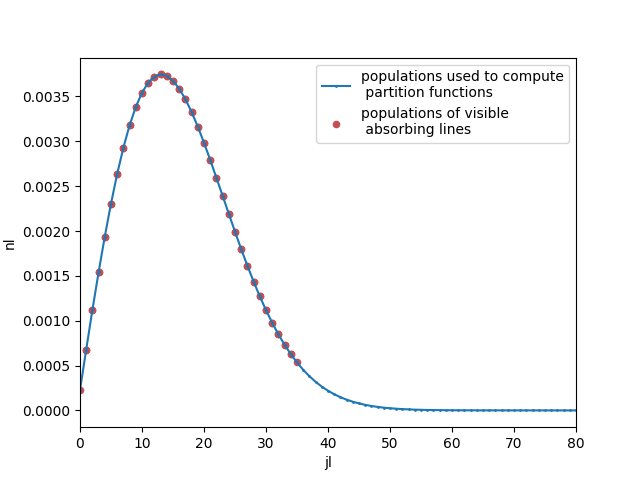
Below we plot the populations
We could also have used plot_populations() directly
pops = s.get_populations("CO")["rovib"]
/home/docs/checkouts/readthedocs.org/user_builds/radis/checkouts/master/radis/spectrum/spectrum.py:2710: UserWarning: Populations valid for partition function calculation but sometimes NOT for spectra calculations, e.g. CO2.
                         See help on how to use 's.lines.query' instead, for instance in https://github.com/radis/radis/issues/508.
                         Turn off warning with 'show_warning=False'

  warn(
Plot populations :
Here we plot population fraction vs rotational number of the 2nd vibrational level v==2,
for all levels as well as for levels of lines visible in the spectrum
import matplotlib.pyplot as plt

pops.query("v==2").plot(
    "j",
    "n",
    label="populations used to compute\n partition functions",
    style=".-",
    markersize=2,
)
s.lines.query("vl==2").plot(
    "jl",
    "nl",
    ax=plt.gca(),
    label="populations of visible\n absorbing lines",
    kind="scatter",
    color="r",
)
plt.xlim((0, 80))
plt.legend()
<matplotlib.legend.Legend object at 0x72085fce16a0>
Print all levels information
print(f"{len(pops)} levels ")
print(pops)
print(pops.columns)
7766 levels
       v   j             E  ...             n        Qrot      nrot
0      0   0      0.000000  ...  1.754208e-03  362.691791  0.002757
1      0   1      3.845033  ...  5.233590e-03  362.691791  0.008226
2      0   2     11.534953  ...  8.626674e-03  362.691791  0.013559
3      0   3     23.069466  ...  1.187857e-02  362.691791  0.018670
4      0   4     38.448131  ...  1.493823e-02  362.691791  0.023479
...   ..  ..           ...  ...           ...         ...       ...
7761  48  38  89299.135499  ...  2.237048e-21  360.424333  0.003612
7762  48  39  89447.643402  ...  1.853601e-21  360.424333  0.002993
7763  48  40  89599.882150  ...  1.526677e-21  360.424333  0.002465
7764  48  41  89755.845909  ...  1.249931e-21  360.424333  0.002018
7765  48  42  89915.528699  ...  1.017299e-21  360.424333  0.001643

[7766 rows x 13 columns]
Index(['v', 'j', 'E', 'Evib', 'viblvl', 'gj', 'gvib', 'grot', 'Erot', 'nvib',
       'n', 'Qrot', 'nrot'],
      dtype='str')
Print visible lines information :
print(f"{len(s.lines)} visible lines in the spectrum")
print(s.lines)
print(s.lines.columns)
274 visible lines in the spectrum
             wav           int      A  ...  hwhm_gauss  hwhm_voigt     shiftwav
0    1900.341948  3.611000e-29  12.70  ...    0.004067    0.016713  1900.339087
1    1902.414094  2.342000e-31  25.42  ...    0.004072    0.017474  1902.411257
2    1905.778626  9.225000e-29  12.80  ...    0.004079    0.016872  1905.775770
3    1907.676322  5.419000e-31  25.62  ...    0.004083    0.017672  1907.673489
4    1911.187693  2.314000e-28  12.90  ...    0.004091    0.017028  1911.184842
..           ...           ...    ...  ...         ...         ...          ...
269  2291.548184  1.147000e-28  22.14  ...    0.004905    0.017153  2291.544414
270  2293.336772  4.506000e-29  22.21  ...    0.004909    0.017008  2293.332974
271  2295.082654  1.738000e-29  22.28  ...    0.004912    0.016901  2295.078829
272  2296.785684  6.582000e-30  22.35  ...    0.004916    0.016752  2296.781832
273  2298.445721  2.449000e-30  22.42  ...    0.004919    0.016609  2298.441844

[274 rows x 47 columns]
Index(['wav', 'int', 'A', 'airbrd', 'selbrd', 'El', 'Tdpair', 'Pshft',
       'line_mixing_flag', 'gp', 'gpp', 'branch', 'jl', 'vu', 'vl', 'ju', 'Eu',
       'Evibl', 'Evibu', 'Erotu', 'Erotl', 'gju', 'gjl', 'grotu', 'grotl',
       'gvibu', 'gvibl', 'gu', 'gl', 'viblvl_l', 'viblvl_u', 'band', 'Qrotl',
       'Qrotu', 'nu_vib', 'nl_vib', 'nu_rot', 'nl_rot', 'nu', 'nl', 'S0', 'S',
       'Ei', 'hwhm_lorentz', 'hwhm_gauss', 'hwhm_voigt', 'shiftwav'],
      dtype='str')
We can also look at unique levels; for instance sorting by quantum numbers v, J
of the lower level : vl, jl
print(
    len(s.lines.groupby(["vl", "jl"])),
    " visible absorbing levels (i.e. unique 'vl', 'jl' ",
)
141 visible absorbing levels (i.e. unique 'vl', 'jl'
line_survey() is also a convenient way to explore populations and other line
parameters, for instance
s.line_survey(overlay="absorbance", barwidth=0.001, lineinfo="all")

Total running time of the script: (0 minutes 0.356 seconds)